Married!

Hello there. Yeah — you. The one who thought I was MIA/AWOL/just plain dead.

I will be the first to admit that I’ve been remiss in keeping my site up to date. As a former professional web developer, the kiss of death for any site in my bookmark list was always when a site was no longer updated on a timely basis. Sort of the way this one has been of late. After all, why should I pay more attention to a site than the owner does?

So who knows what sort of readership I still have left for the House of Rapp — if any.

In my defense, however, I’ve got a great excuse. I went from being unattached to dating to engaged to married in a little over a year. If you know anything about me, you’ll know I’m very methodical about important matters, and this sort of thing is uncharacteristic, to say the least. However, it’s definitely the best thing that’s ever happened, too.

My fiancee — er, I mean “wife” (I’m still getting used to that!) — and I just returned from a fantastic ten day honeymoon in Hawaii. My only experience with the 50th state had come from a few visits I’d made to Honolulu when I was a kid. And Kristi had never been to Hawaii at all. I explained that Honolulu was basically a major metropolitan area and might not impart the romantic solitude we were seeking. So we ended up honeymooning on Maui, and what a great decision that was! Not nearly as sleepy as Kauai, but far less urban than Oahu.

Anyway, the past months have involved working, planning a destination wedding in San Luis Obispo, registering, the honeymoon, and of course the process of combining two households. My routine has been anything but normal, so finding time to write has been scarce. I aim to change that, however.

OK, you’re probably here because of an interest in aviation. So, on the flying front, I’m still flying King Airs for Dynamic Aviation. For the past 18 months or so, there really hasn’t been any movement in the pilot ranks. No upgrades, no new hires. But over the past few weeks we’ve had three upgrades, an announcement of a new base manager, and other developments.

I’m not sure this portends any sort of upswing in the overall aviation sector, however. These are mainly replacements for existing King Air captains who are moving on to other bases or jobs within the company. Nobody I’m aware of is being hired by airlines, fractionals, or charters. In fact, Netjets, the 500 pound gorilla of the Subpart K world, just announced it was laying off about 500 pilots. So the pain continues. The Netjets news was particularly disheartening to me, because flying for them is my ultimate career goal.

Aerobatic competition has been nil for the past year. Sad, but with the move to the Advanced category, I really don’t feel good about just jumping into things. I want to ensure I can fly the sequences safely and be competitive. Do it right or don’t do it at all. That’s my philosophy. I’ve done some judging, coaching, and instruction, just not much competing.

The RV transition training has been picking up nicely. I think I’m starting to get a stronger reputation as a Socal guy that knows RVs. The next step is really for me to get a side-by-side model — probably an RV-6 — that I can use for transitions. The problem with using the student’s aircraft is that often it’s not available. It either hasn’t been purchased, or the builder hasn’t made the first flight yet. I’ve started to delve into what’s required for an FAA training exemption so that I can hire the aircraft out for these flights. Without that exemption, it is not permissible to rent an Experimental airplane.

So that’s the story. Thanks for sticking with me and being patient. I’ll leave you with a link to a web site I created for the wedding. It’s got quite a few photos, stories, and other stuff on there. Our wedding was aviation-themed, so you’ll at least want to get a look at the photo of the cake.

Gyroscopic Precession

Do you fully understand the famous “turning tendencies” which act on propeller-driven aircraft?

It’s one of the first things primary students are taught when flight training commences. And the concepts are not all that complicated. Yet I’ve found that even long-time instructors often lack a proper understanding of at least one of these forces, specifically gyroscopic precession.

Here’s an excerpt from one of Bob Miller’s Over the Airwaves newsletters:

“An unexpected stall, coupled with four powerful left-turning tendencies of a single engine airplane in a steep climb and insufficient right rudder, could easily produce a left hand spin.”

I wrote Bob to tell him that I only count three “left” turning tendencies and ask him to identify the fourth one.

He replied to my question by asking which three I was counting. I said slipstream, torque, and p-factor (propeller factor).

Bob responded by saying I was missing “gyroscopic effect of the spinning propeller. Pull it up, a force will be exerted to the left.”

Really?

Nope. That’s literally 180 degrees off. Rotate a tricycle gear aircraft and the aircraft will yaw to the right. Gyroscopic force is expressed 90 degrees ahead in the plane of rotation. The prop spins right (as seen from the cockpit). That means the force will act as if you pressed on the propeller disc from the LEFT side, and the plane will yaw about the vertical axis to the RIGHT.

In a tailwheel aircraft it MAY be opposite, but the gyroscopic force is dependent upon how the airplane is rotated. Or should I say, whether it is rotated at all. In a Super Decathlon, I allow it to fly off in the three-point attitude. Since I’m not pushing the nose down (or up, for that matter), there is no gyroscopic effect. In the Pitts, on the other hand, I often rotate more to a level flight attitude before leaving the ground, so I get some left yaw.

But gyroscopic effect is not a “left turning tendency”. We (aerobatic pilots) use gyroscopic effect all the time to yaw the plane left, right, up, down, flatten spins, accelerate spins, tumble the airplane end-over-end, and do many other things.

Assuming you’re flying a SE aircraft with clockwise engine rotation, torque always wants to roll the plane left, p-factor always wants to yaw it left (ok, unless you’re flying with zero or negative AOA), and slipstream always goes around the fuselage the same way. But gyroscopic effect does not remain constant. It depends where the force is applied to that propeller disk.

I believe this concept is poorly understood because most pilots don’t generate pitch or yaw rates with enough acceleration to really see the effect of gyroscopic precession. It’s also another example of how the training and knowledge of even experienced pilots are frequently incomplete without the benefit of that flying laboratory we call “aerobatics”.

MOA Flying

There are many types of “special use” airspace out there. One of the most prevalent is a Military Operations Area, or MOA. According to the Aeronautical Information Manual (Sec. 3-4-5):

a. MOAs consist of airspace of defined vertical and lateral limits established for the purpose of separating certain military training activities from IFR traffic. Whenever a MOA is being used, nonparticipating IFR traffic may be cleared through a MOA if IFR separation can be provided by ATC. Otherwise, ATC will reroute or restrict nonparticipating IFR traffic.

b. Examples of activities conducted in MOAs include, but are not limited to: air combat tactics, air intercepts, aerobatics, formation training, and low-altitude tactics. Military pilots flying in an active MOA are exempted from the provisions of 14 CFR Section 91.303(c) and (d) which prohibits aerobatic flight within Class D and Class E surface areas, and within Federal airways. Additionally, the Department of Defense has been issued an authorization to operate aircraft at indicated airspeeds in excess of 250 knots below 10,000 feet MSL within active MOAs.

c. Pilots operating under VFR should exercise extreme caution while flying within a MOA when military activity is being conducted. The activity status (active/inactive) of MOAs may change frequently. Therefore, pilots should contact any FSS within 100 miles of the area to obtain accurate real-time information concerning the MOA hours of operation. Prior to entering an active MOA, pilots should contact the controlling agency for traffic advisories.

d. MOAs are depicted on sectional, VFR Terminal Area, and Enroute Low Altitude charts.

One of my pet peeves is a misunderstanding about Military Operations Areas which leads many pilots and air traffic controllers to believe that any VFR aircraft flying inside one must be a “knucklehead” (a controller’s description!). From an ATC or military pilot perspective, perhaps this is the case. After all, what possible justification could a non-military pilot have for going into one of these MOAs when it’s active? Just go around it! Right?

Wrong.

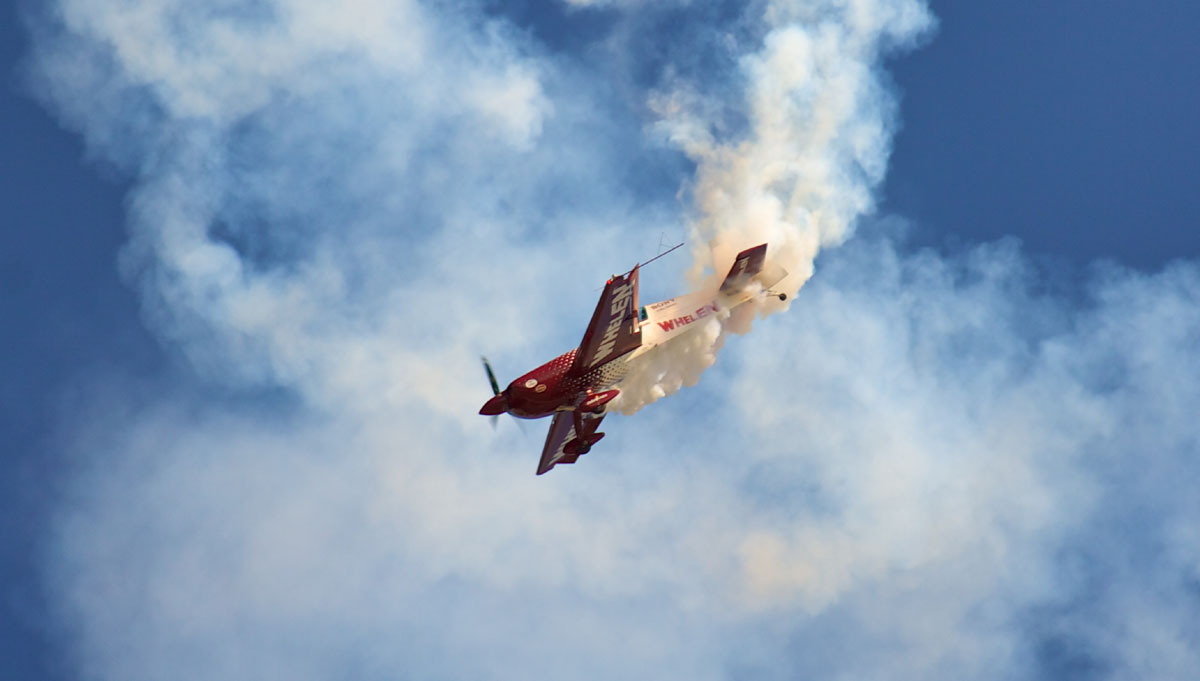
Extra 300 flying a vertical uplineAs I said in a reply to this Jetwhine article, I fly a lot of high performance aerobatics in a south Orange County (Calif.) area known as the Blockhouse. There is no protective MOA on the chart for us, and we often have climb and descent rates which exceed 15,000 fpm. Consider: an Extra 300 pulling into a vertical upline at 180 knots TAS is traveling straight up at 18,228 fpm.

We’re out there with minimal fuel flying very high performance maneuvers while trying to teach students. I’ve seen as much as +10G on the accelerometer, and as low as -6G. Inverted flat spins. Tumbles. Rolling turns. And I’ve given and received formation and aerial interception training. So I’m quite familiar with the sort of high performance maneuvers which make it hard to watch for other traffic.

Those who say non-military pilots should simply “always stay well clear” of an active MOA irk me because it ignores many practical matters regarding this special use airspace.

First, what if I’m trying to get to Inyokern, Tehachapi, or Kern Vally airports, all of which lie in the middle of the Isabella MOA? You literally cannot get there without flying through a MOA.

Half the high desert airports around my neck of the woods are in the middle of MOAs. Pull out a sectional and look at them.

Second, what if weather dictates a deviation which takes me through a MOA? I’ve encountered this scenario several times. I’m ferrying a Pitts S-2B which has a 23 gallon fuel tank and burns ~13 gph. Should I deviate another 75 nm out of the way to go around it? Many of these MOAs are in hot, high desert areas here in the southwest, and often thunderstorms, terrain, fuel, turbulence, wind, or other factors come into play, depending on the aircraft in question.

Finally, if the activity is dangerous enough to non-participating aircraft (a gunnery range, etc.), it should be a restricted area. Now that’s an airspace I wouldn’t want to fly into if it was hot, even if I legally could. I’ve seen active restricted areas at night and the tracers were bright enough to light up the sky. The sound of the artillery could be heard even above the noise of the aircraft’s engines! But MOAs are not restricted areas. And there’s a reason for that.

Having said that, I don’t take flying into a MOA lightly. I know there are high performance military aircraft out there doing their thing. I know budgets are tight, their flying time is minimal, and I don’t want to be the cause of their having to break off some training exercise simply because I was in the way. But keep in mind, the airspace is JOINT-USE. We do have a right to be there, and there might be a darn good reason for our presence as well.

Time for a Beat Down, Becker

Matt working on the Extra 300\'s com radioTalk about art imitating life.

I snapped this photo today while Sunrise’s chief mechanic worked on the Becker com radio in our Extra 300. I had taxied out to the non-movement boundary and been attempting to contact clearance delivery (and ground, and tower, and company, and…. you get the picture) to no avail.

It was curious. We seemed to receive transmissions perfectly well. There was side-tone. The radio indicated that it was transmitting.

Now on the one hand, if a radio is the weakest part of your airplane, life can’t be too bad. On the other hand, it costs about $6 per minute to operate this aircraft, and the only other person on board the plane is the guy footing the bill. And he came all the way from Thailand to get some professional aerobatic training, not pay for me to idle there in the taxi lane. So we shut down the aircraft.

I knew the camera system processor had just been reinstalled. Perhaps something was loose or got bumped during that maintenance? Nothing looked amiss, but I double checked the antenna connections, tried a different helmet, checked the front seat headset jack connection, circuit breakers, etc.

Nothing.

Eventually, I called our mechanic, who knew enough to come over with a replacement radio. You see, this wasn’t the first problem we’ve had with this piece of equipment. Maybe it’s the 15 years worth of 10G pulls, but that radio has been back to the manufacturer more often than Joan Rivers has been to the botox clinic. Every time, Becker fixes it, certifies it, sends it back, and it works great.

For a while.

So when Matt pulled out the old radio and set it down on the pilot’s seat, I got the impulse to find a baseball bat and re-enact that classic Office Space scene where they take their frustrations out on a recalcitrant printer. Oooh, that would be so satisfying. The radio frequency knob shattered into a thousand tiny black pieces. The rectangular LCD screen leaking black fluid onto the ramp. Vengeance!!

I suggested this to Matt, who said he’d already tried that tactic and it hadn’t worked. From the tone of his voice, I got the impression that, unlike the printer, this thing fights back. “You want a piece ‘a me??”

Don’t tempt me, punk.

With the new radio installed, we were able to complete the flight without any light gun drama. And I will admit, at least the radio had the decency to fail on the ground and not in mid-air. Still, that Becker better hope I don’t find it just sitting on a shelf one day. I might have to steal something from work…

Back in the Saddle Again

“Riding the range once more, toting my old Pitts S-2B…”

Doesn’t quite have the same ring, does it? No matter. It was so nice taking the Pitts up today — I made two practice flights at the Blockhouse, concentrating on the Intermediate Known sequence for the upcoming season. It’s a bit tougher than last season’s sequence. The total K value (difficulty) is about the same, but this year it’s front loaded with harder figures, while at the end of the sequence the K values drop off significantly.

2008 intermediate known sequence

My practice strategy seems to differ from most aerobatic pilots. For whatever reason, most pilots begin by working with individual figures. On the surface this seems like a logical building-block approach. However, I prefer to run the new sequences all the way through until I can do them without any hard zeros. My reasoning is that a beautifully flown sequence is of little value if you zero most of it because you end up going the wrong direction or misread the card. Also, by the time the sequence can be flown properly, it should be clear which figures need the most work.

Let’s just say I have a long way to go before this is ready for public consumption. I’m trying to get ready for the Copperstate contest in Arizona, which will hopefully tune me up enough to benefit from a training camp in Borrego so that when the California season begins at Apple Valley, I will at least have a fighting chance. Last year, I didn’t fly for the whole season. Then I had one practice flight to prepare for the AcroFest. In case you were wondering, I do not recommend that training regime.

Anyway, back to the present. As usual, my 45s are shallow going up, steep going down, and I have to recalibrate my sense of the aircraft’s energy state going vertical. In other words, I keep torquing out of push humpties and other such maneuvers because I’m spending too long on the upline and running out of energy. I’m sure my rolls aren’t centered on the appropriate lines, either.

These things always happen in the off season. It’s almost as if I have an internal mechanism which falls out of adjustment after a period of inactivity. The frustrating thing is, I’ve been flying every day, and flying the Pitts a lot, too. But it’s primarily been demo flights, checkouts, advanced spin training, rides, and other non-competition stuff.

I haven’t even started working on rolling turns or getting my snap rolls back in order. All day long my snap rolls had an extra 200 degrees of rotation before I could get them stopped. But that’s okay. I’m glad just to be up there, zooming through the sky without a care in the world.

In honor of my new focus on not sucking this season, here are a group of pilots who definitely don’t stink: The Four Horsemen. This team still flies, but now it’s down to two Mustangs and they’re simply called “The Horsemen”. This video clip is well edited, and best of all, there’s no narration from an air show announcer. I’m not a big fan of announcers in general, but in this case it would be outright sacrilege. When a quartet of Mustangs is in the air, an announcer — whoever he may be — should just be quiet and let the sound of those Merlin engines speak for itself.

But that’s just my opinion.

These Are A Few Of My Favorite Things

Now is this a sweet looking pair of machines or what? A 1993 Pitts S-2B and a 2008 Honda Accord Coupe in matching paint:

I had the opportunity to get back into the Pitts yesterday and when I saw the two of them together I had to take a picture. It’s so rare that both the car and the plane are clean at the same time.

I was out at CNO to take Dan for a flight. His flight review (an FAA-mandated recurrent training requirement) was due and I owed him a favor for ferrying me out to Borrego last fall. I had needed to get out there to retrieve the Pitts after the Acrofest. I was the Contest Director for that competition. And a competitor. And a judge. And… I’ll never do that again. It was a crazy time, even by my standards.

Anyway, Dan wanted to try some advanced spin training as part of his flight review, so we focused on flat and accerated spins modes. After that, I went up for a solo flight to work on the 2007 intermediate known sequence. I’m trying to get an early start on preparing for the upcoming competition season.

The 2007 season was basically missed by all of us at Cloud Dancers because the airplane was undergoing a particularly heavy maintenance interval which lasted for most of the spring and summer. The timing was unfortunate, but after the aircraft came off leaseback it only made sense to get it into good working order. The wings were off, the prop was overhauled, fabric & paint were touched up, the top end was overhauled, and she was cleaned, rigged, inspected, and so on.

When I got back to Chino, I spent some time just shooting landings in the pattern. It’s such a blast to go from 1300′ AGL to zero in about 15 seconds. The airplane pretty much climbs at the same rate. I had forgotten how much sprightlier the S-2B is when flown solo vs. with two people on board. Losing that 200 lbs up front really makes a difference!

I’ve been doing a fair bit of Pitts flying lately, but most of it has been dual in an S-2C owned by one of my recent Part 61 private pilot grads. This airplane was originally owned by a good friend from the aerobatic competition circuit named Reinaldo. The person Reinaldo sold it to installed a wicked six-camera video system and sold it again shortly thereafter, leaving my student as the lucky beneficiary of this upgrade. Here we are preparing to start up during a recent flight:

Fortune Cookie

Confucius say:  you are admired for your adventurous ways

I think there was a mix-up somewhere and I got this guy’s fortune by mistake.

The Case for Spin Training

Bob Miller at Over the Airwaves frequently touts the fact that ‘nobody’ provides spin training anymore. Perhaps my perspective is not typical, but I don’t find this to be the case.

At Sunrise Aviation (KSNA), we have the largest aerobatic program on the west coast. Not only that, but our private pilot students are all required to experience spins in a Decathlon before they solo. We’ve taught thousands of people to fly over the past quarter century using this philosophy. I was trained this way myself.

I can think of several other large operations which provide quality spin training just here in California. CP Aviation in Santa Paula, Attitude Aviation in Livermore, and Tutima Academy in King City.

I rarely have any problem getting pre-solo students to do multi-turn spins on their own (and recover on a specified heading). It’s simply a matter of proper technique when teaching this to students. Easier said than done. Most CFIs learn from instructors who have never done spins. There is no way they will effectively be able to teach it without proper spin training of their own.

Many pilots and instructors who do expose students (and perhaps even more egregiously, non-pilots) to spins introduce them by simply doing one unannounced. That is the worst possible idea. It guarantees the maneuver will simply blur by for the student, resulting in spatial disorientation and motion sickness. It also ensures they won’t learn anything other than to be afraid of flying.

More than any other maneuver, spins come with a long litany of baggage. Horror stories from other pilots. Tall tales of spins that swallow the aircraft whole like Moby Dick. Apprehensiveness about motion sickness. This requires delicate handling by the CFI, but instead it’s often approached with blunt force. “Just do it”.

Wrong approach.

Teaching spins must begin with a thorough understanding of the aerodynamics involved. That means ground training. I start with a review of how lift is developed. Then progress to a discussion of stalls, coordination, wing drops, and finally the aerodynamics of the spin itself. When teaching spins, the best advice for a CFI is: assume nothing. I’ve seen some really weird explanations from spin students about basic aerodynamics. One of the most common errors is a belief that aircraft stall at a specific speed rather than a specific angle of attack. The ground training is the place to get all that stuff taken care of.

In the air, it’s vital that the spins are worked up to slowly, beginning with stalls of various types. Falling leaf stalls are particularly valuable. The student must be comfortable with high angles of attack. Then, spin “drills” are introduced were the spin is started, then stopped within a quarter turn. Once the student’s technique and comfort have reached the requisite levels, a one turn spin can be introduced with appropriate ground reference. From that point it’s simply a matter of allowing the spin to develop through two and three turns while ensuring the student maintains situational awareness.

For the really apprehensive students, I begin the actual spins by having them work only one control, usually the rudder. Once they’re comfortable with that, I switch them to the stick. Then I have them do both, and eventually give them the throttle as well.

I also teach students the difference between a spin and a spiral dive. They are easy to confuse with one another if you don’t know what to look for. For students who take to the spins with more alacrity, I will sometimes introduce aggravated spin modes. Keep in mind these are all pre-solo students with maybe 20 hours of total flight time.

I’ve taught spins to countless students using this method. I’ve never had one get sick. I’ve never had one who didn’t feel more comfortable and confident with spins, stalls, high deck angles, high AOAs, and unusual attitudes afterward.

The importance of practical spin training doesn’t stem from the likelihood of encountering one inadvertently. If proper coordination is maintained (and it’s often not — that is why we have these stall-spin accidents), pilots are not likely to ever encounter one in the heat of battle. No, the best reason for teaching spins is to eliminate the “fear of the unknown”. Once they’ve completed the spin training, students uniformly feel that spins are “not nearly as scary as I thought”.

Personally, I think a lot of landing accidents are caused by a lack of spin training. Students who are afraid of spins will be afraid of deep stalls. It’s only natural to fear the unknown. Those wing drops can be scary if you don’t understand what’s causing them, what will happen if you don’t correct properly, and how the resulting spin entry should be handled. A fear of stalls means they’ll be apprehensive about high angles of attack and low airspeeds. So they approach the runway with too much energy just to be on the safe side, with predictable results.

There are many excellent reasons for practical spin training, but it’s hard to make any headway with those arguments when the FAA proclaims said training as unnecessary. To me, the proof is in the pudding. I see people every day who have had no spin training. It’s usually accompanied by poor rudder skills, limited understanding of the related aerodynamics, and a lack of appreciation for the importance of coordination. The low quality of basic airmanship skills can be quite dramatic.

And besides, just think about all the fun they’re missing out on!

Have you had spin training? If not, find a good aerobatic instructor and get the lead out. You won’t regret it.

Turbine Toucan

I first saw this on the wall in a restroom at Cable Airport. No joke. For reasons I can’t begin to fathom, someone had taped a photo of this aircraft to the wall:

Turbine Toucan biplane

It’s called Turbine Toucan, and it’s just another ho-hum aerobatic biplane, just like my Pitts. Except that it boasts something most modern jet fighters can’t even claim (no, I’m not referring to the paint scheme): a positive thrust-to-weight ratio.

This thing weighs 2000 lbs and the turbine engine puts out 3300 lbs of thrust. That’s an amazing 1.65:1 ratio, enough to accelerate in a vertical climb. Indefinitely.

Even fighter jets with positive thrust-to-weight ratios — of which there are few — can’t match Turbine Toucan’s performance in this department. The F-15 Eagle, for example, is about 1.12:1. Even the latest and greatest generation of jets like the F-22 Raptor (at 1.26:1) and F-35 (1.22:1 with 50% fuel) can’t compare.

Among aerobatic aircraft with reciprocating powerplants, only the most pumped up Sukhois and Edges approach the performance of that magical 1:1 ratio. I ran the numbers on the Pitts S-2B and was surprised to find 0.95:1, because it sure doesn’t feel that sprightly on the uplines. Maybe I need to go on a diet?

Eh. More likely it’s due to the high level of drag from the Pitts’ biplane design. That’s my story and I’m sticking with it.

This isn’t the first time someone’s had the bright idea of putting a big turbine engine on a featherweight aerobatic airplane. Wayne Handley did it back in the late 90′s with his Oracle Turbo Raven. Equipped with a 750 hp Pratt & Whitney PT6A turboprop powerplant, that monoplane sported a 1.47:1 thrust-to-weight ratio. Still not up to the Turbine Toucan standard.

Handley frequently demonstrated a vertical climb where he would stop in mid-air, hover, and then accelerate upward again. I never had the opportunity to see the Turbo Raven in person, but from what I’ve been told it left quite an impression. I think of it has a GA equivalent of vectored thrust. Handley would take off directly into a half Cuban, then perform a vertical half-roll and push over into a steep descent which ended with a landing in the exact same spot he’d departed from 60 seconds earlier.

Sadly, the Raven was badly damaged in a 1999 accident (see video). Wayne Handley was injured but has since recovered and still trains aerobatic pilots at his private airfield in central California.

Being a biplane, I can’t help but wonder if the Turbine Toucan will beat the Turbo Raven’s time-to-climb records. Toucan has a higher thrust to weight ratio, but will certainly be hampered by higher drag. The Raven climbed to 3,000 meters (9,842 feet) in one minute and nine seconds seconds, a rate of 8,560 fpm.

Initial testing of the Turbine Toucan yielded an 8,400 fpm climb rate at about 50% power, but that was based on a sea level climb to 4,500′ MSL. Even with a turbine engine, as the airplane climbs, thrust will decrease. Drag will decrease as well in the thinner air, so I think it’ll be close.

As a biplane owner, I’m going to have to root for the Turbine Toucan. (Sorry, Wayne!)

Air on a Six-String

A Picture is Worth a Thousand Words

Hopefully, the old saying is true, and will make up for my largess in the writing department as of late. Don’t worry, I’ll be turning out the tripe again soon enough. Until then, enjoy these photos of:

  • Elixir of Love – a very well recieved production of this classic opera, set in a 1950′s west Texas diner. Think of it as opera infused with a Grease-esqe panache. The show just closed last night.
  • Carmen – yes, again.
  • SoCal RV Rendezvous – I presented a seminar on aerobatics at this gathering of RV pilots. If I recall the numbers correctly, more than 50 aircraft showed up. It made for some impressive photos of the ramp…
  • Wild Animal Park backstage tour – this is probably the best way to get up close and personal with the cheetah, tiger, lion, and other cats while seeing how things work behind the scenes. Well worth the ~$20 cost.

RV Aerobatics

User fees.  TFRs.  High fuel prices.  Increasing regulation.  A tight insurance market.  It seems everywhere we turn these days, there’s a new challenge for general aviation.  And that goes double for the aerobatic community, which by its very nature has additional noise and public relations issues with which to contend.  IAC membership is down.  Here in Southern California, we’re being relegated to ever smaller and more distant chunks of airspace in which to legally do our “thing”.

How depressing!  There are days when I question whether this avocation of ours will survive.  So it was with great pleasure that I accepted an invitation last month to present a seminar on aerobatics at the Socal RV Rendezvous, a regional gathering of homebuilt RVs.  Fifty seven aircraft and more than 100 people showed up.  The event coincided with IAC’s recent push to be more inclusive of recreational aerobatics, and the RV Rendezvous reinforced in my mind the wisdom of that shift.

According to Vans Aircraft, 5,024 RV-series airplanes have been built and flown thus far.  Thousands more are under consruction around the country, and the rate at which they are achieving flight status is increasing rapidly as the build time drops.

Aside from the 350 RV-9/10 models, every one of those 5,024 airplanes is designed for aerobatic flight.  This represents the largest aerobatically capable fleet in the world.  Compare these 5,000 RVs to perhaps the most ubiquitous competition aircraft, the Pitts.  According to Aviat, approximately 700 factory built and 600 homebuilt aircraft are in that fleet worldwide.  The Extra?  I counted 258 of those on the U.S. registry.

I’ve been involved with the RV community since a friend of mine started building his RV-7 in 2001.  I pounded rivets on his plane and had a chance to watch one come together from the ground up.  My general impression is that these aircraft are quite conventional and well designed.

I’ve flown the RV-4, RV-6, RV-7, and RV-8.  I wouldn’t consider them to be especially well suited for competition, primarily because the clean design, flush riveting, and careful fairing of the draggy bits mean the airspeed will build quickly when pointed downhill.  That’s not to say they cannot be flown in competition.  They can, and they have been.  You’d just have to work harder to ensure the airplane’s limitations are not exceeded.

When you get to recreational aerobatics, that’s where the RV shines.  RVs are light in roll but somewhat heavier in pitch.  Reminiscent of a Pitts, though not quite as heavy in the lateral axis.  A true pleasure to fly.  They actually gain altitude throughout most sequences, something you don’t often see in airplanes with 160-200 horsepower.

Speaking of drag, an aerobatic flight in an RV will open your eyes to just how draggy most of our competition airplanes are!  All that horsepower under the cowl of your S-2B or Sukhoi is designed for vertical penetration.  Speed is, to a certain extent, an enemy when you’re competing.  It will carry you through the box too quickly.  The RV was designed for speed because they are used for cross country transportation.  Put that 300 hp engine in an RV and it will go a lot faster than any Extra 300, Edge 540, or Velox.

I’ve flown a wide variety of Sportsman-level maneuvers in RVs, and they perform remarkably well as long as the energy is properly managed.  Spins, aileron rolls, loops, immelmans, cubans, hammerheads, barrel rolls, and the split s are easily done in an RV within a +3.5/-0G range.  This is well within the designer’s stated design limits of +6/-3G (and ultimate load factors +9/-4.5G).  Airspeed limits such as Vne, Vno, and Va are high enough that RVs can fly through these maneuvers without danger of overspeeding the aircraft.  Throttle management, unusual attitude training, and a clear understanding of the RVs slippery aerodynamics are key to safety in these birds.

Unlike certificated airplanes, RVs come in many flavors.  Different engines, props, canopy styles, landing gear configurations, etc.  Much like a Citabria, Stearman, or Cub, most of them do not have inverted fuel or oil systems, so I will modify maneuvers like the half Cuban by rolling upright as soon as the 45 degree inverted point is reached in the loop.  Remember, we’re just talking about recreational aerobatics.  These guys aren’t going to fly competition in their pride and joy.  They just want to be able to safely perform basic figures.

On the topic of safety, my primary goal at the Socal RV Rendezvous was to encourage RV pilots seek out quality instruction before attempting acro in their aircraft.  This is smart advice for any aspiring aerobat, but it’s especially true with the RV for two reasons:  first, the aforementioned sleekness of the airframe.  And second, builders are often out of the air completely for several years while they focus on construction.  Their Phase One flight testing may have been prepared for with recurrent flight training, but very infrequently does that training include aerobatics.  Yet aerobatics must be included in the flight testing if it’s going to be added to the approved maneuvers in the airplane’s operating limitations.

On the way home, I couldn’t help but marvel at the strength and energy in the RV community.  We could use a little of that in our local IAC chapter, don’t you think?  There are five thousand of them out there, so let’s start recruiting!  And if you have the opportunity to take an aerobatic flight in an RV, don’t pass it up.  I’ll bet you’d be pleasantly surprised with what those little kit planes are capable of.

Bill Kershner Goes West

Aviation legend Bill Kershner, renown throughout the GA community as an instructor and author, has died.

Dog-eared copies of Kershner’s Advanced Pilot’s Flight Manual are on the bookshelves of countless pilots.  He’d been flying since 1945, and by my count, he must have been in his late 70s.

Kersher was cool.  He lectured at the UT Space Institute.  Kershner was old, but not crotchety.  He was modest, yet confident.  AOPA has a page of video clips and article reprints on the man.

We’re in an era when aviation is more synonymous with “money” than ever before.  The flying world tends to pay you little notice unless you’re in a half-million dollar composite SR-22 or Columbia.  Or the aerobatic equivalent, an Edge 540.  Bill Kershner did his thing with an old C152 Aerobat, training “over 600 students, including 45 Army aviators, FAA test pilots, lectured and flew spins at the Navy Flight Test School at Patuxent River, MD three separate summers, and taught aspiring Navy and Air Force pilots”.

That’s what I call “the right stuff”.  RIP, professor.


Switch to our mobile site