August 6, 2005
…Down Mexico Way

I’m back from Mexico and can report that no animals were harmed in the making of this dive trip. No non-human animals, at least. Er… well, we did catch quite a few trigger fish during the surface intervals, but I don’t count those because they make for such tasty ceviche.

I’ve got quite a few pictures to post in the photo gallery, but I’ll whet your appetite with some highlights.

The new Schulz house in San Carlos is really something to behold. I’d estimate the size to be more than 3,000 square feet. Newly constructed on the side of a hill overlooking the bay, this pad is equipped with a home theatre, high speed internet access, a gourmet kitchen, and is furnished so smartly that it looks like something out of a Pottery Barn catalogue:

Living room

The house sits atop a hill about 150 feet above the water level. Here’s a photo I snapped on our last day of diving as the boat re-entered San Carlos Bay:

Exterior as seen from the harbor

One of my favorite rooms was the TV room. Or, if you prefer, “home theatre”. Equipped with a big screen TV, satellite hookup, surround sound, leather sofas, and a wet bar for those times when you get hungry for a liquid snack:

Home theatre

Here’s one photo I took on the patio during a typical Mexican sunset. The ever-present towering cumulonimbus clouds can be seen in the background. They do get some spectacular thunderstorms down there; mother nature is in charge and she never lets you forget it. Keep in mind that this image is not retouched or edited:

A typical sunset at Casa de Schulz

It’s not all fun and games. The mosquitos came out en mass every morning and evening. Without bug spray you’d be eaten alive. Not to mention the heat and humidity, which can be far more oppressive than anything you’ll find in Arizona or Florida. But that’s the way Mexico is, and once you adopt what I call a ‘tropical mindset’, it becomes more like a relaxing sauna you can just melt into. Anyway, it’s tough to convey a real sense of what it’s like standing on that deck watching the sun set over San Carlos Bay, but this panoramic will give you a general idea (click on the image to zoom in):

Panoramic view of San Carlos Bay from the lower deck of the house

For me, the real test of any Mexican residence is how well the shower drain functions. I’ve been to Mexico dozens of times. Rosarito, Cozumel, La Paz, San Carlos, Hermosillo, etc. And in every case, no matter where I’ve stayed, the shower drains clog like the lungs of a three pack a day smoker. It’s irksome because I have this thing about showers. See, I like to use them to get clean. But that can be tough to do when you’re standing in a tepid pool of filthy water. This time, however, the drains ran clear for the entire week. A Festivus miracle!

The diving was great — how could it not be when you’ve got a pimped out 38′ boat and a dozen college friends as part of the deal? I’m happy to say I’m one of the few who was in the water for every single dive, even after late evenings anchored by Cuervo 1800.

One dive sticks out as particularly memorable. Due to some unfortunate currents, four of us — all highly experienced — ended up marooned on a rock for half an hour while the boat shuttled around to pick up divers who’d been carried off by the water. Lounging on the rock wasn’t so bad, but eventually we had to jump back in and make a 50 yard surface swim through waters peppered with the dreaded Portuguese Man-of-War.

The craziest thing from the trip was actually an article from the August issue of Outside Magazine about an airline pilot named Dave Shaw. Shaw liked to dive — deep. He set a world record by reaching a depth of 927 feet in a South African freshwater cave called Bushman’s Hole. For those of you who don’t dive, recreational divers are supposed to limit themselves to about 60 feet. Even highly experienced divers rarely pass 100 feet. By the time you reach 300 feet, air is no longer breathable because under that much pressure it becomes toxic to the human body. A man-made mixture of helium, nitrogen, and oxygen must be used instead. Anyway, I won’t give away what happened to Shaw, but you can read the article here.

The coming and going from Mexico was interesting. First of all, one of our divers has been in Mexico City for the past few months and decided to travel to San Carlos the cheap way, via bus. It took Seth more than 36 hours. Read all about it.

I thought he was crazy to be traveling by bus, especially since I made the savvy decision to go by air. Yeah right. It took me 36 hours to get home! Which is especially maddening when you consider that my conveyance was travelling at 500 mph, more than 10 times the speed of Seth’s taco bus.

Here’s what happened. First of all, the America West Dash-8 was about four hours late getting to Guaymas to pick us up. There was some sort of mechanical delay in Phoenix. Then, we dodged thunderstorms all the way to Phoenix only to find the airport closed by the weather. We held for more than an hour before diverting to Tuscon, which was totally unprepared for us. We got AW to comp us some lodging, but not before Arnie let off a little steam at a supervisor. The next morning, our flight from Tuscon to Phoenix was late departing, and I barely made my connecting flight to Orange County. Most of the guys on this trip drove, and they made it home in 1/3 the time it took me via America West. The old saying is true: “Time to spare? Go by air!”

There is some talk of diving in Honduras next year. The destination was voted on and unanimously approved over dinner, but virtually everyone at the table was drunk at the time, so who knows. Wherever we end up, I’ve no doubt it’ll be an adventure.

Posted by Ron at 10:25 pm | Permalink | Print
Category: Diving, Travel | Comments (2)
August 22, 2005
Bird Strike

Several aviation blogs have touched on the subject of bird strikes recently, and it reminded me of a wildlife encounter I had almost exactly a year ago.

The day started pleasantly enough. I met up with Dan over Chino and we formed up as a flight of two enroute to Crystal Airpark. We spent an hour or so with the builder of an RV-6 which was up for sale, after which Dan and I parted ways. He returned to Chino and I winged northbound toward Lake Isabella to pick up some folks for Angel Flight.

I dodged thunderstorms most of the way, arriving a few minutes late only to discover that a) I’m the last AF pilot to arrive, and b) two pilots cancelled so unless I can take an extra person, they’d be stranded there. Plus there’s a lot of extra luggage. So we try to see how much of it we can fit in the plane. Would you believe 14 duffle bags and sleeping bags? Plus 50 gallons of fuel. Plus three passengers. And yours truly, of course, who tips the scale at 200 lbs.

The baggage compartment was a solid wall of bags all the way up to the window. There were bags under the rear seat. They were holding luggage on their laps. Bags in between the seats. My flight bag (which is quite large) was under my legs.

The baggage wasn’t heavy — primarily lightweight sleeping bags and such. I ran a quick weight & balance and true to form, the Skylane was just a few pounds under max gross. (I later realized that I forgot to include my own weight, so we were actually over. Oops.)

Then as we taxi out I notice it’s 105 degrees. And at the end of the runway, of course, is…. a huge lake.

So I add 10 degrees of flaps, add full power, and decide where my “no go” point will be on the runway. Suffice it to say the plane got off the ground very quickly. Not that I doubt the POH’s takeoff distance charts, of course. But when it’s 45 degrees above standard, some serious interpolation must take place to accurately predict aircraft performance.

She didn’t climb more than 500 fpm, but that’s fine. Good job, Ron. Nothing can stop you now!

Except perhaps a bird strike.

It was over pretty quickly. A large flock passed by the nose, and out of maybe 30 birds, only one got caught. The ultimate ‘zigged when he should have zagged’, eh? These birds were moving so quickly that there was no avoiding the collision. If you’ve ever encoutered a helium balloon on departure, you’ll know what I mean. It appears out of nowhere and is gone before you can even process what you’re seeing, let alone take evasive action.

There was no damage to the airplane. Not even the slightest nick on the prop. But it sure was a mess, and naturally I’d just cleaned the plane the day before. After landing at Brackett Field, I found pieces of the bird(s) on the prop, cowling, windshield, top of the wing, bottom of the wing, wing tip, wheel fairings, belly, and vertical stabilizer. Imagine putting a piece of food in a blender but leaving the lid off. Wheeee!

It didn’t qualify as a prop strike since there was no slowing or stoppage of the propeller. The bird was, thankfully, rather small. Even so, blood is like oil. It doesn’t take much to really look bad.

Oh, and did I mention how fun it is trying to get a pop-up IFR clearance into POC when a dozen other AF pilots are trying to do the same thing? I got vectored around for nearly 30 minutes. Made a lovely approach, great landing, and expected the usual “taxi to parking, monitor this frequency” from the tower.

Instead, he says “Contact ground”. Well my front seat passenger was holding the approach plates for me (rule one: use all resources), and after we landed he started leafing through it, so I didn’t have the ground frequency on hand.

Now I could have pulled the data out of the GPS or loran, or fished through the CA Pilot’s Guide or Airport/Facilities Directory. But it’s been a long day, I’m hot, my airplane is covered in blood, and the AF/D is buried in a flight bag which is stuffed under my seat. So I decide to just ask the tower if they can give me the frequency.

He comes back with, “It’s the published frequency, sir. The frequency that’s published. The published frequency is 125.0. That’s 125.0. It’s published.”

Moron.

Posted by Ron at 2:16 pm | Permalink | Print
Category: Aviation | Comments Off
Victor Belenko

One of my first inspirations for getting into aviation was a Russian named Victor Belenko. In 1976, he defected to the U.S. from Russia in his MiG-25 Foxbat.

At the time, the Foxbat was the most feared and super secret airplane in the world. It flew faster and higher than anything the U.S. had, and he flew one right into our lap. He stole it on a routine training mission, outran the Russian jets that were pursuing him, and landed in Japan on an airfield that was 30% shorter than any runway a MiG-25 had ever seen.

Anyway, his book was written in 1980, and I always wondered what happened to him. Turns out he’s still around, and a friend of mine is now his agent, booking him on the speaking circuit.

The book has all kinds of funny anecdotes about his acclimatization to American life. In a magazine article in 1996, he expounded a bit more on some humorous stuff he did while getting used to our society. Check this out (makes you glad to live in America!):

“Belenko: First of all American super-market, my first visit was under CIA supervision, and I thought it was set-up; I did not believe super-market was real one. I thought well I was unusual guest; they probably kicked everyone out. It’s such a nice, big place with incredible amount of produce, and no long lines! You’re accustomed to long lines in Russia.

“Later, when I discovered the super-market was real one, I had real fun exploring new products. I would buy, everyday, a new thing and try to figure out its function. In Russia at that time (and even today) it’s hard to find canned food, good one. But everyday I would buy new cans with different food. Once I bought a can which said “dinner.” I cooked it with potatoes, onions, and garlic — it was delicious. Next morning my friends ask me, “Viktor, did you buy a cat?” It was a can of chicken-based cat food. But it was delicious! It was better than canned food for people in Russia today. And I did test it.

“Last year I brought four people from Russia for commercial project, and I set them up. I bought nibble sized human food. I installed a pâté, and it was cat food. I put it on crackers. And they did consume it, and they liked it. So the taste has not changed. By the way, for those who are not familiar with American cat food. It’s very safe; it’s delicious, and sometimes it’s better than human food, because of the Humane Society.

“I bought a box of Freedom with the picture of nice looking lady. I did not know what it was. (I’m talking about maxi-pads.) I brought it to my apartment, I opened it, and I tried to figure it out. I thought well it’s probably some cleaning device for the kitchen to give these American women freedom in the kitchen to clean up and absorb everything, because even today Russian women do not have this convenience.”

Posted by Ron at 11:33 pm | Permalink | Print
Category: Aviation | Comments Off
August 23, 2005
Aviation Blogs

I’ve added some new aviation-related blogs to my links page. It’s about time, too. I periodically search for sites like these, but find them few and far between on the internet.

Thankfully, I found a way to leech off the research of others! I simply looked up the Bloglines lists of some people who subscribe to the RSS feed here at The House of Rapp.

Among the discoveries are an official Boeing site for the flight test program of the new 777-200LR jetliner, two sites written by airline pilots, and another which is penned by a freight dog here in California.

Posted by Ron at 12:07 am | Permalink | Print
Category: Aviation, Site News, Weblogs | Comments (1)
Cancer Sucks

A few years ago, most of my donations were to Angel Flight, a very worthy aviation-based charity which provides medical transportation to those in need. I also did a lot of flying for AF.

Lately, though, most of my charitable dollars have gone to organizations fighting cancer. It wasn’t a conscious change, but one that I now see was prompted by the fact that nearly everyone I know is being directly affected by cancer. My niece has had it — twice. Paul’s mom has it now. So does Jason’s wife. Both my sisters-in-law have had it. And the list goes on.

So it’s apropos that Lesley is fundraising for the Light The Night Walk, the Leukemia & Lymphoma Society’s nationwide evening walk to build awareness of blood cancers and raise funds for cures. Walkers carry illuminated balloons — white for survivors and red for supporters — to celebrate and commemorate lives touched by cancer.

According to LLS, approximately 747,465 Americans are living with blood cancers right now. Leukemia causes more deaths than any other cancer among children and young adults under the age of 20.

Odds are nearly 100% that you know someone who had, has, or will have some form of blood cancer. So please consider making a donation to help Lesley reach her goal of helping the Leukemia & Lymphoma Society reach theirs.

Because cancer really does suck.

Posted by Ron at 10:32 am | Permalink | Print
Category: General | Comments (3)
August 24, 2005
Extra, Extra!

Extra 300

This is my newest ride! What do you think? Sunrise needs another Extra instructor and I draw the lucky straw.

I started getting familiar with this baby today. The cockpit checkout was interesting; it’s far more sparse than other Extras I’ve flown. This aircraft is one of the older 300 models (no -L or -S suffix, just a plain old 300), and the main difference seems to be the mid-wing.

The visibility looks perfectly fine to me, especially after occupying the front seat of a Pitts S-2B, but I can see why they shifted the wing to the bottom of the fuselage in subsequent models. Not only does it improve the viz, but it’s a bit easier to get in and out of the aircraft as well. I’ve been told that the mid-wing is better from an aerobatics perspective, but at this level the opinions may be a bit subjective. On the other hand, the Edge 540 is a mid-wing design, so there’s probably something to it.

Anyway, if I can make the financial end work out, perhaps I’ll be flying this in intermediate next season. It would be nice to move into an airplane that I could take all the way to unlimited. An S-1 would be cheaper to operate, but I’d eventually be faced with another transition, something that’s time consuming and expensive.

The Pepsi and Sunrise logos on the airframe are sort of hokey, but they do impart that sense of flying in the big leagues. Those guys have logos on everything.

I should probably be a little nervous about flying this thing. There aren’t any cheap parts on it. One guy I know had to replace the canopy on his 300L and the glass alone was something like $18,000. It might have included the canopy skirt. Either way, that’s a lot of coin. On the other hand, at solo weight the Extra 300 can be stressed to +10/-8g. It’s hard to put a price on that.

Posted by Ron at 10:42 pm | Permalink | Print
Category: Aerobatics, Aviation | Comments (2)
August 26, 2005
Dude, Where’s My GPS?

I’m not one of those ‘all technology sucks’ guys who look down my nose at a well equipped instrument panel. I fly the Cirrus SR20/22 and G1000-equipped DiamondStars all the time and really enjoy teaching glass panel stuff. Indeed, I’ll be the first to admit that GPS is the best thing to come along since sliced bread.

But when I started instructing, I realized that my own basic navigation skills had deteriorated. I knew this not because I ever got lost, but because I was vaguely uncomfortable without a GPS, as though I couldn’t reliably remain clear of airspace in the Los Angeles basin without it. That was embarassing, because any student pilot is required to demonstrate that skill on solo flights before they can even think about obtaining a private pilot certificate. And here I was, an instructor, feeling less than totally comfortable with it.

Since then I’ve flown minimally equipped aerobatic airplanes on long cross countries with nothing but a map and compass and have come to enjoy the challenge. When flying in actual IMC, I’ll take every tool available to me. But when traveling in VMC, I almost prefer to use a compass and a chart because it builds and preserves a lot more skill than using GPS. It also literally forces me to keep my head outside the cockpit, which is good for all sorts of reasons.

Despite the fact that I enjoy using GPS in the clouds, I don’t let my instrument students do it unless they’re flying a glass panel airplane. This may interpreted as an old codger cooing about how much better things were in the ‘good old days’, but at Sunrise we work the instrument students pretty hard. Not for it’s own sake, but to turn out decent instrument pilots who can handle anything that comes along.

I’m teaching one guy now who’s only done a half dozen approaches in the airplane so far (though he’s done a dozen or more in the sim), and I’ve already got him going partial panel in a very busy environment. We’ll launch out of SNA with a clearance to Long Beach (maybe 10 miles away) and request the NDB approach, which he’ll do partial panel. It’s not easy. You takeoff, and less than 2 minutes later you get cleared for the approach. And before that the student has to get the ATIS, set the altimeter and DG, review altitudes, setup and ident the radios, review the missed, set the markers, verify minimums, and so on.

Before I’m done with him, he’ll be able to do a partial panel, single radio non-precision approach. The crowning feat is doing the no-gyro NDB 19R at SNA. It’s on a southerly course, so the compass errors are maximized. And there are a lot of closely spaces step-down fixes. It’s not because I think anyone will ever do that approach in real life — and certainly they’ll never do it partial panel. I teach them to do that because it’s extremely demanding, and I want to push them to their limit (and beyond) on every flight. Like a muscle that’s been exercised, it breaks down and then rebuilds itself even stronger.

I’ve no illusions about what these guys will do after getting their instrument rating. They’ll start flying with GPS. I don’t think that’s a bad thing. There’s no debating that it’s more accurate and capable than any other form of electronic naviation. But they’ll have the knowledge and skill to handle high-workload approaches with instrument failures in busy airspace.

Instrument flying is almost purely a mental exercise and here in Socal you’re always getting vectored around, so I demand that students always know exactly where they are and never rely on a controller for situational awareness. On an ILS, they have to track the cross radials, use the DME, and time the approach. If there’s a navaid they can use, they’d better be using it. If they get vectored, they better know where they’re being vectored to. And if they’re sent across the final approach course, they must know it’s happening and query ATC accordingly.

I recently flew with a guy who trained at Sunrise about 10 years ago. He hadn’t flown instruments for nearly that long, but his training came back and he was flying to high standards almost immediately. He accurately self-diagnosed his errors, weak points, and knew how to fix them.

On the other hand, I’ve flown with guys who had instrument ratings but were terrible pilots. One — get this! — held an instrument rating but had never done a circling approach before. That should not be possible; you have to demonstrate a circle-to-land on the checkride.

We were doing the ILS 29R at Torrance and were told to circle north for runway 11L, and he turned to me and said “what is that?”. I replied, “It’s a circling approach” and he came back with “I don’t know what that is.” I had to ask several times to reaffirm what he’d told me. It didn’t seem within realm of possibility. The negligence of his instrument instructor — and the examiner — was almost beyond comprehension.

He also accepted clearances he didn’t understand, couldn’t hold headings or altitudes to anywhere near PTS standards, and was so far behind the airplane that I terminated the checkout and told him he was not going to be able to get IFR privileges without major remedial training on the basics. Truth be told, he’d probably have to start over from square one. I wish I could say that this guy is a fluke, but it seems to be a common occurance. I’m not talking about rust here. The average pilot flies something like 60 hours per year, and a bit of rust is expected. But this is downright poor training.

In the final analysis, the problem isn’t the GPS, it’s the laziness of students and instructors who don’t see a problem with relinquishing major pilot-in-command responsibilities to ATC, GPS, or just good old fashioned fate.

Posted by Ron at 12:01 am | Permalink | Print
Category: Aviation | Comments (2)
August 29, 2005
Foo Fighters Good; Sony Bad

Some of the most relaxing moments of the San Carlos dive trip were had during surface intervals on the boat. A ’surface interval’ is a period of time spent on the surface in between dives. This time allows the body to naturally rid itself of excess nitrogen accumulated while breathing compressed air at depth. Without an appropriate surface interval, a diver runs the risk of having this nitrogen come out of solution in the blood and form bubbles which can cause pain, vomiting, paralysis, and even death.

Anyway, our surface intervals were typically in the 60-90 minute range. We’d use the time to eat lunch, fish, and just relax. Well one day, David put the new Foo Fighters CD, In Your Honor, in the boat’s CD player. It’s a two disc set — one hard rock, one acoustic. The acoustic side was just mellow enough to fit perfectly with that quiet contemplative time out on the water. I really loved it and made a mental note to pick up the album once we got back to the States.

I finally got around to it today, and the first thing I did was rip it to my hard drive so Retrospect could back it up tonight along with the rest of my data. Few people back up CDs for disaster recover purposes, but who among us hasn’t scratched a CD just enough to turn it into a $14.99 coaster? I also use the local copy to free myself from having to schlep the CD back and forth between the car and house.

So much for simple plans. I discovered that Sony uses a copy protection scheme on the album which prevents the listener from burning an archival copy of the CD. The technology, from Sunncomm International, is called MediaMax. It stops rippers (I tried Winamp, Easy Media Creator, Nero, and Media Player) from doing the deed. Some may appear to rip the tracks, but when you listen to them they skip incessantly.

Got an iPod or use iTunes? Then you’re out of luck, too. As Sunncomm explains it, “Apple’s proprietary technology doesn’t support secure music formats other than their own, and therefore the secure music file formats on this disc can’t be directly imported into iTunes or iPods.” You’re essentially limited to using Windows Media Player or another ’secure’ player that MediaMax can get its claws into.

Needless to say, this stinks. Thankfully, J. Alex Halderman at Princeton University has dissected the MediaMax copy protection system and found an easy way around it.

Basically, MediaMax works by installing a proprietary driver as soon as the CD is inserted. This driver not only prevents ripping of protected content, but won’t even allow said content to be played unless the appropriate licenses are present. So disabling the copy protection is as simple as a) disabling the MediaMax driver, and b) ensuring the Windows auto-play functionality doesn’t have a chance to reinstall it.

For the nitty gritty, check out Halderman’s site. The instructions were stone simply and only took me 30 seconds to accomplish. Since then, I’ve been able to rip, archive, and play the Foo Fighters CD as though the copy protection scheme never existed. Because as far as my computer is concerned, it never did.

To the best of my knowledge, circumventing MediaMax neither immoral or illegal. I’m simply making an archival copy for my own use, and not doing anything I could’t do by simply carrying the CD around with me wherever I go. Reverse engineering the MediaMax software is prohibited by the license agreement, but then, I never agreed to it. And even if I had, I’m not reverse engineering anything. I’m simply removing a driver from my system — something I’d want to do anyway. Windows gets so cluttered up with needless software that it slows boot up times and consumes precious memory. Efficiency and security both dictate that any services not absolutely required for operation be disabled or downright removed from Windows.

If I’d known this copy protection junk was on the album, I never would have bought it in the first place. I love the music, but at the end of the day my money went to support — and therefore encourage — Sony’s adoption of intrusive software which prevents me from using music I paid for in ways which are completely legal.

Posted by Ron at 4:43 pm | Permalink | Print
Category: Diving, Pop Culture, Technology | Comments (5)
August 30, 2005
Fuel for the Fire

Sometimes I wonder if I’m the only one that sees the “big picture” the way I do. Recently, a fellow pilot in Arizona took the time to write about the escalating fuel prices and what this rise in energy costs is doing to the economy

Groceries are already going up in price here, it’s in small increments but if you think back to last year it’s clear many items are up 30% or more.

Ron, this fuel cost is going to change our country completely. I go through about 20 gallons of gas a week in my car. Not long ago that cost about $25, now it’s $60. Multiply that by 52 weeks a year and it’s now costing roughly $2000 more a year for one car. That’s about what my C310 insurance costs.My 100LL cost has doubled in the last 2 years, and flying is soon to become the private club of the seriously rich.

If you aren’t a multi-millionaire with a million coming in each year that adds up fast. I used to not even give it a second thought when I wanted to pull into a restaurant and buy a meal for me and my kids. Now I think 3 times before deciding. This gas price is pulling money out of areas that once were a routine part of my life and others. Everyone is going to suffer, the restaurant owners I used to visit 3 times a week aren’t going to see me but once every 2 weeks maybe. It just keeps being passed down the chain.

Hope springs eternal, let’s hope prices fall quickly before it wrecks this economy for years and changes a way of life we’ve known since the 1950’s.

Indeed. The fuel prices are really out of control. As I work in the transportation industry, there’s no choice but to pass the cost on to the customer. The Extra 300 we rented for $200 in the mid-late 90’s goes for $311 now. And unless you’re flying it solo, tack on another $55 an hour for the CFI. The Super Decathlon that was recently $130 or so is now $140, and it’s sure to go up again within days.

I wonder if the Chinese are paying through the nose like we are. Or the Europeans. If their gas was $8 a gallon a couple of years ago, does that mean they’re paying $12-15 a gallon now?

I couldn’t agree more about flying becoming a domain of the wealthy. It’s not just the gas prices or insurance. Landing fees are being instituted at more and more places. Santa Monica, for example. We’re totally priced out of airports like McCarran and San Francisco Int’l. And the airports that are cheap are either being closed (Rialto), are overcrowded (John Wayne), or are in such out of the way places that there’s no reason to go there (San Bernardino). The government is now openly discussing user fees, which would discourage pilots from using safety services.

I think that inflation is not only high, but rapidly accelerating. There was an article on CEO pay on CNN.com today which showed how the rich are getting richer. The top 10 CEOs have, over the past ten years, made something like $15,000,000,000. In case the zeros are making you dizzy, that’s fifteen billion dollars.

That’s not how much they’ve made for their companies, it’s how much they’ve been paid by their companies.

This I can at least understand, if not condone. Actually, I take that back. I don’t understand it. But the real estate mania leads me to believe that either a) the average Californian really can afford a $1 million home, or b) there’s something seriously out of whack.

Money aside, the usefulness of the general aviation system is being destroyed and no one seems particularly bothered by it. Except, perhaps, those of us who can’t do much about it. I’ve tried writing letters. A lot of them. I’ve commented on NPRMs, written to newspapers, legislators, and bureacrats. If I’m lucky, a pasty form letter will be my reward, and it will come 3-4 months after I’ve written, so whatever issue or vote was on the radar has long since vanished. You can almost hear the novice voice of the 4th string flunky who printed out this mealy form letter, which by the way doesn’t even address the issue on which I’ve written, but is so generic in nature as to cover anything related to the committee or panel on which he/she sits.

Sure, I like to fly. But it goes beyond that. We are rapidly catching up to the Europeans in socialization. And we’re adding our own pathetic twist in the form of homogenization. We all eat at the same chain restaurants, drive the same cars, shop at the same chain stores, and live in the same cookie cutter homes. You’re not a person anymore, you’re just a number.

This is no way to be. The last refuge of individuality and real character seems to be things like general aviation, which far too many people already see as the pervue of some rich white guys.

Sad to say, the price of things makes them a little more right as each day passes.

Posted by Ron at 2:22 pm | Permalink | Print
Category: Aviation, Economy/Finance, Politics | Comments (5)
August 31, 2005
C-130 Bird Strike

Bird strikes make for dramatic photos. And the larger the bird, the greater the drama.

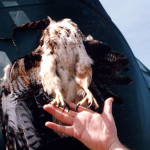
Here’s the aftermath of a right-of-way arguement between an Air National Guard C-130 and an eagle. As usual, the bird came out on the losing end. It looks like the pilot almost did, too.

Speaking of which, our hero’s had a long day. “Looks like I picked the wrong week to quit smoking…”

C-130 bird strike Eagle carcass Bad day at the office

Posted by Ron at 10:34 pm | Permalink | Print
Category: Aviation | Comments (7)