I’d be the last person to defend Michael Jackson (or his music). But he went free because those who testified against him had serious credibility problems that the prosecutor couldn’t overcome.
Jackson has plenty of credibility issues of his own, which is more than enough to convict him at the office watercooler. But in American courtrooms, the onus is on the prosecution to remove any reasonable doubt from the minds of the jurors. When both sides have credibility issues, as they did in this case, the presumption of innocence goes to the accused and he moon-walks free.
The case was not tried very well by the prosecutor. I mean, what was the deal with the conspiracy charge? As far as I know, this charge was essentially ignored by the DA. They presented no evidence to support conspiracy. Yet Jackson was charged with it. This only bolsters the defense’s case, because if they can bring doubt into the mind of the jury on one charge, then all may be suspect.
I’m not saying it’s fair. Or that Jackson “didn’t do it”. Only that this is the way our system works. It’s biased in favor of the defendant. By design.
Harmonia Baroque Players is a professional early music ensemble based here in Orange County. While I’ve been running their web site on a volunteer basis for a number of years, the look & feel has always made me cringe, especially because their quality of their music (listen) is not represented accurately by the pathetic FrontPage design.
So I took matters into my own hands the other day and brought it into the 21st century.
Out with the old…

… and in with the new:

I’m pretty happy with the new site, especially considering I whipped it together in about six hours from start to finish. Goodbye FrontPage, hello CSS.
Harmonia Baroque is far from the only organization out there with a lousy web presence. In fact, I’d say that most 501(c)(3) non-profit arts organizations have poor web sites. Cluttered, infrequently updated, poor user interface, lack of content, and so on. It’s especially sad when you consider that arts organizations are tailor made for the web due to their multimedia nature. Visual arts groups can post photos of their exhibits, music groups can put up sound clips, etc.
So while I can’t fix them all, at least the early music strata on the World Wide Web is looking a little prettier. And I can admit to working on the Harmonia site rather than suddenly pretending I don’t speak English when asked about it. Now that’s what I call a win/win.
So I recently got back from my third aerobatic contest, the Northern California Aerobatic Challenge at Paso Robles. I finished in second place, a nice surprise considering some serious obstacles were encountered along the way.
After the Apple Valley contest (where I finished in sixth place), the plane developed a crack in the right fuel tank. Replacing this tank definitely falls into the “heavy maintenance” category, as it includes removing the wing from the aircraft, ripping open the top of the wing, replacing the tank, recovering the wing, doping and painting it, reattaching the wing and flight controls, and a thorough test flight.
The general consensus, based on previous wing tank replacements in this airplane, was that there was virtually no chance the plane would be done in time for Paso Robles. The lead time for even getting a new fuel tank was estimated to be several weeks.
There was some talk of flying a standard Decathlon or trying to work out a deal to use one of the northern California airplanes, but nothing ever came of it. Which was fine with me, becase after flying the Super D in the high density altitude at Apple Valley, I want more power, not less.
Paso Robles was pretty much written off in my mind until a week or so before the contest, when I heard that not only did we have a tank, but it had already been installed in the wing and the maintenance department was preparing to reattach it to the fuselage. Within a few days, the plane was back on line and ready to go.
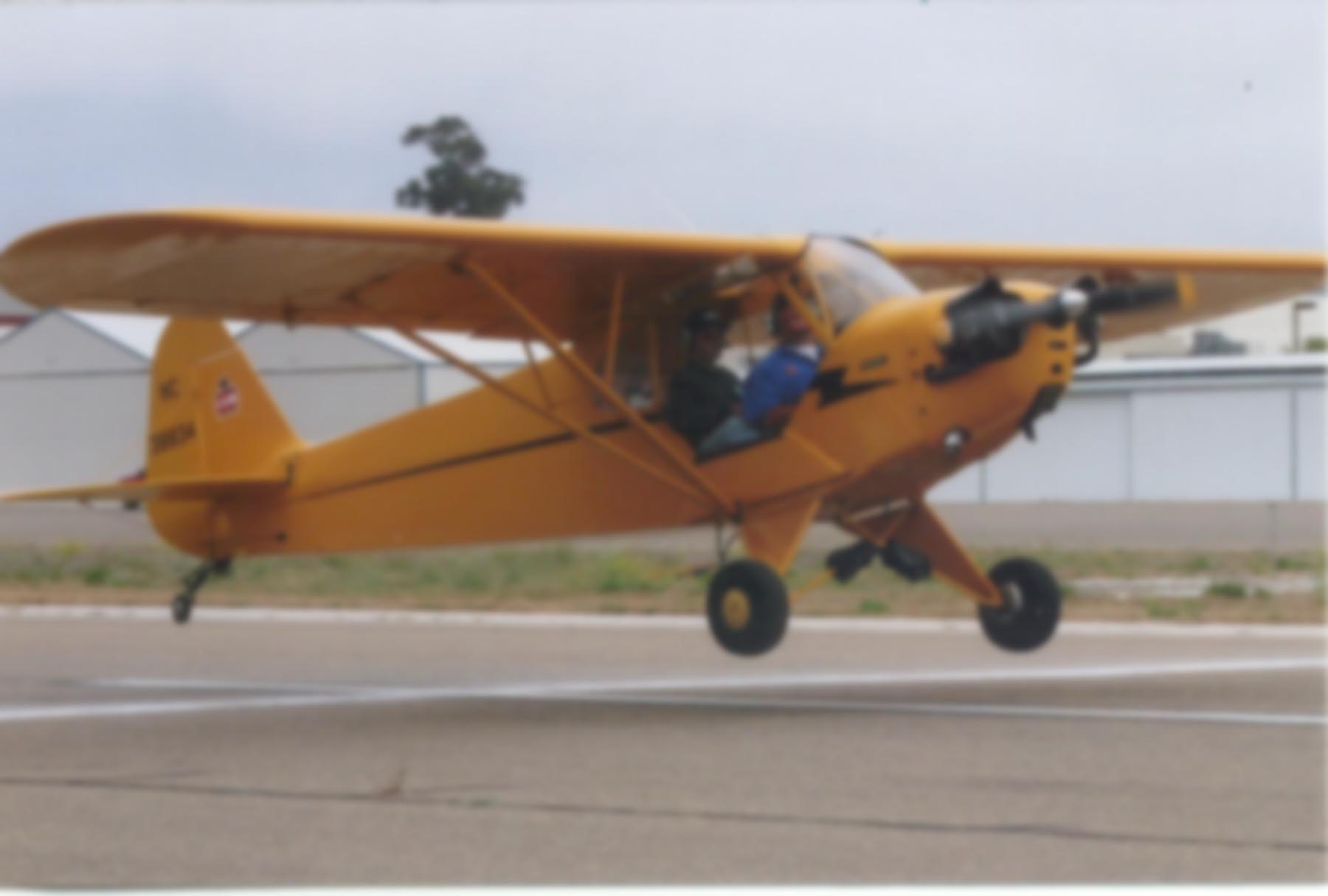
As usual, I ferried the Super Decathlon to the contest. It’s always a nice change from instructional flying, because I don’t have to do anything but fly the plane and enjoy the view. Oh yeah, and navigate. The Super D has no navigational equipment of any kind on board, so I get to fly cross country using nothing but a compass and sectional chart. In an era of $300 GPS receivers, this kind of pilotage is something everyone learns in primary training but typically never uses again on non-local flights.
A persistent stratus layer along the coast made the navigation somewhat challenging. Many of the typical waypoints were under the clouds and I was left with a homogenous mountain range to find my way up to PRB. But find it I did.
So things were looking up on Thursday. The weather was great. The plane was in good shape. And I had a coveted early time slot reserved for practicing my sequence in the aerobatic box (every competitor gets 15 minutes of practice time the day before the contest starts). I took off around 10 a.m. and ran through the sequence once just to shake off the rust. I was pretty happy with how it went, and felt good during the climb back up to 5,000 MSL.
I came into the box a second time and pushed the nose over to gain speed, wagging the wings good and hard as you’re supposed to when starting a sequence. It was on the third wing wag that the stick froze — and I mean it locked up tight.
Initially I didn’t realize that it was only the ailerons that were immobilized. All I knew was that the airplane was 45-50 degrees nose down, approaching Vne, and some very important bits were not working properly. There had been no grinding, binding, clicking, or anything else in the control system. It was perfectly smooth and normal right up to the point where it froze.
They say time slows down when something like this happens. I wish. I’m sure there was a moment of denial on my part, but it didn’t last very long. I pulled the throttle to idle and was moving my hand down to the elevator trim slider when I realized that the stick would still move back and forth, just not laterally. It had stuck so firmly that I initially thought both elevator and aileron control had been lost.
The relief didn’t last long, becase it was about this time that I realized that the ailerons were deflected and the aircraft was rolling right at about 10-15 degrees per second, slow by aerobatic standards but more than enough to get my attention now. As I raised the nose, I instinctivly glanced at the outboard sections of the left and right wings, but there was no apparent abnormality with the control surfaces.
By this point the Super D had rolled about 40 degrees to the right. I started to use ever increasing force on the stick, hoping to overpower whatever obstruction was in the system, but it was to no avail. I used both hands. No good. Then I made a fist and whacked the stick from the side as hard as I could. Nada.
Time for plan B, the only alternative: full left rudder, which I had already started to feed in while working on the stick. Thankfully it stopped the roll. I added in some throttle to increase airflow over the tail, which improved rudder authority enough to overcome the deflected ailerons and return the airplane to a semblance of level flight.
So there I was, slipping through the sky without any idea of where I was headed. Lord only knows what the folks on the ground were thinking. I took a moment to catch my breath and then keyed the mike to let the starter (the contest equivalent of an air boss) know there was a problem.
Eventually the stick came free on its own after a couple of minutes of me just sort of slopping through the sky trying to figure out how I was going to land it like that. When I got it back on the ground, Bill and I pushed the plane into the hangar and spend the next eight hours taking it apart. Every cover came off, the seat came out, the carpets and floorboards were removed, the bellcrank tunnel came out, the stick boots were pulled, the wingroots were pulled off, the whole nine yards. We inspected the airplane below the floorboards (where the cables run) from the tailcone to the firewall with flashlights, mirrors, and more.
Eventually we found an unused 2″ pop rivet near the wing root aileron pulley. If you’ve never seen one, pop rivets have a long metal shaft that is used to drive them. We had one of the competitors who is also an A&P look at it and he was able to duplicate the jam using the pop rivet. My theory is that when I pushed over to go into the box, the negative Gs allowed the rivet to float up to the control cable, which was moving back and forth during the wing wags. Eventually it got stuck in the pully.
Anyway, we visually inspected every single inch and component of the aileron system and didn’t find anything else, so we test flew it again without incident. But that’s the first time I ever seriously considered bailing out of an airplane. I was totally calm about it, but the adrenaline really kicked in, so much so that later on when we were working on the airplane, I got really sleepy once it wore off.
Last year the airplane had a broken elevator cable during a flight. So now that the ailerons have had their moment in the sun, I’ll be expecting the unexpected from the rudder.
Just kidding. But it does prove once again that the first few flights after maintenance are one of the most dangerous times to be in an aircraft. The wing had been off the plane for the installation of the new fuel tank, and the mechanics did it pretty quickly. So that’s probably what happened — they just left an extra pop rivet in there. I rather like the composite planes that have the translucent inspection panels in the tail so you can look for this stuff before flying. Of course, in this case, that wouldn’t have helped since the object was in the wing root.
Throughout the next couple of days, I was regaled with stories of other aerobatic pilots who’ve been killed by FOD (foreign object damage). The guy who won first place related how his first aerobatic instructor got killed in a Yak 55 when some FOD got stuck in the elevator during a sequence.
So I’m not sure I won second place as much as it was God paying me back for all the hell He put me through.
With respect to the infamously confusing aerobatic box at Paso Robles, it didn’t confuse me, but it did get Bill. On his 2nd flight, he torqued out of the hammerhead and didn’t realize it until he was nose down, and then when he saw the box markers at an angle, he corrected the wrong way and zeroed that maneuver. He also did the final maneuver on the Y-axis, so that knocked him out of contention. He was probably tired after working his tail off to help find out what was wrong with the plane, so I think that played a part in it.
The key at PRB seems to be ignoring the runways. If you look beyond them, you’ll notice that the field section lines that radiate out across the valley are perfectly aligned with the box. But yes, it’s tough because the box is a square and it’s overlayed on a triangular runway.
Surprisingly, it wasn’t difficult to fly the airplane in the competition. I thought after the incident with the aileron jam that I might be reticent to fly the Super D really hard, but I just went out to have fun and ended up flying it harder than ever. It was great being down near sea level instead of up at 8000 foot density altitudes.
The flight home was interesting, too. On the way back the clouds obscured the southern half of the state, so I flew back in formation with the Pitts (he has a GPS) and we just circled down through a hole over Huntington Beach.
As always, when I got back many people asked how the contest went. I can sum it up by saying “I learned about flying from that.”
So I’m waiting to board my United Airlines flight to Seattle. A few days ago I was congratulating myself on resisting the temptation to fly up in my own airplane, opting instead to take advantage of frequent flyer miles to obtain a free ticket.
Now that I’m here, however, the plan doesn’t seem quite so bright. Oh sure, the flight is on time and I didn’t forget to pack anything. But the environment here at LAX is strangely disquieting. I’m not sure why, but I think it has something to do with the fact that I’m at an airport, surrounded by airplanes, and this should be a very joyful environment for someone like myself. Yet there is no joy anywhere to be seen.
There’s something about a major international airport that brings out the worst in people. I don’t know if it’s the crowds, the security, or just the overall nervousness in a post 9/11 world. But it’s definitely not a friendly place.
The TSA goons are constantly eyeing you, as though you’ve certainly committed a crime and it’s only a matter of time until they uncover it or sweat you out.
The gate agents are stand-offish at best, undoubtedly a pre-emptive response after years of torture by a slovenly dressed, poorly mannered flying public.
Listless passengers either immerse themselves in reading material or simply shuffle about, eyes downcast to prevent any possibility of actual eye contact with another human being.
Perhaps I, as a GA pilot, am the only one that detects this pall. It’s like a funeral in here. A testament to the bankrupt status of United Airlines, perhaps? It does feel a bit like “last call” at a seedy bar.
I can only conclude that this is not really an ‘airport’ at all. LAX and its ilk don’t do justice to the word. Lord knows that if this is what my daily work environment was like, I’d be looking for a new career. The ‘airport’ I’m familiar with has quirky people who are friendly to a fault, and always ready to look you in the eye, shake your hand, and swap war stories about that old Stearman sitting out on the grass.
Even before 9/11, the only thing to look forward to at a place like this is the possibility of witnessing a warm reunion between friends or family as folks disembark. Now, even that small pleasure is gone. The only thing there is to look forward to now is getting the hell out of here.
Speaking of which, they’re calling my flight. And not a moment too soon — this place is starting to creep me out.
There’s a rueful old saying which reminds us that while you can pick your friends, you can’t pick your family. Although that’s generally true, a wedding tends to puts the kibosh on that logic. In modern society, at least, you certainly can pick your spouse. And that’s exactly what my nephew Mike did yesterday.
I’ve been to many Jewish weddings, but this was my first orthodox ceremony, and I have to say it was one of the livliest and most joyful marriages I’ve witnessed. There’s something wonderful about five thousand years of history that hangs over the chupah without holding the procedings down, a criticism I’ve had of large Christian weddings where the ceremony can become so theatrical that you almost feel the “fourth wall” appear in front of you.
It was a smallish affair — about 70 guests and a minimalistic wedding party, which was refreshing. When there are 200 people on the guest list it makes you want to run away screaming. (Don’t ask how I know that.)
The ceremony was officiated by two rabbis, one of whom came all the way from Israel. He also dances like the revival of Fiddler on the Roof is holding open auditions and he, in the words of A Chorus Line, “really needs this job”. But that’s another story.
There are a dozen little traditions that make Jewish weddings special, like mikveh (ceremonial cleansing), signing of the ketubah, reading of the seven blessings, and of course the crushing of the glass by the groom at the end of the ceremony, symbolizing the last time he’ll ever put his foot down.
One of the neatest traditions is yichud, a few minutes of private time for the newly married couple between the ceremony and reception. Such a simple thing, but undoubtedly welcome by the bride and groom who are always being pulled in different directions and have little time to themselves on their wedding day.
Anyway, the Rapp family is a relatively small one, so it was cool to see it get a little bigger last night. It was also sad to look around and realize how infrequently I see my family, especially when many of them live in the Southern California area. Of course, as anyone who lives down there can tell you, between traffic and the other complexities of Socal life, it can almost be easier to travel out of state than across the Los Angeles basin.
Tomorrow I’m planning to meet up with OP alumni Tim Proctor. All I know is that he’s living in an apartment that, he claims, is made purely of concrete. Only in the northwest…
No, not that kind of change. I’m talking about coins. Loose change, the kind you find in your pocket. You know, the stuff that ends up under the sofa cushions? That mass of flat metal objects that clunks around in your pants as you walk down the street? The very same stuff that once short circuited a 9-volt battery in my pocket and nearly caused it to explode.
It’s nearly useless in modern society. Inflation has ensured that you can’t buy anything with loose coins. And the stuff it is good for, like vending machines, require so many coins that you need a Brinks armored car full of quarters in order to buy a pack of gum. Coins are heavy, loud, and tends to fall out at the most inopportune time. The best thing I can say about coinage is that it keeps you from having to break any more bills than necessary.
I had a friend in college who used to throw all his coins out the car window as he drove. (Yes, I did have some odd friends.) He especially hated pennies and would toss them with great vengence. His eccentricity was good for a laugh right up to the day that one of his offerings skipped across the road, hit a police car, and broke the windshield.
Good times…
For years, I’ve been collecting change at an unbelievable rate, ending up with probably $50 worth each month. If it weren’t for Coinstar I’d have been buried under a mound of copper pennies a long time ago. Coinstar rocks because you just dump your change into this contraption and it counts it all up for you. No rolling, no stacking, no encounters with surly bank employees who’d rather be enduring Chinese water torture than dealing with a piggy bank full of coins.
Coinstar’s fees are a little steep. They take 9%, which some people have equated with highway robbery. They point out that it costs Coinstar the same amount to count 10 pennies as it does 10 quarters, yet they charge a lot more to count a quarter than a penny.
But I forgive Coinstar their hefty fees because it’s hard to put a price on not having to sort and roll 1,000 coins one by one. My time is worth more than that.
The demented senior citizens who live next to me have a license plate frame on their car which, with six simple words, conveys everything that’s wrong with the world today.
It says: “BACK OFF! Our granddaughter’s a lawyer.”
With all due respect to attorneys I admire, I’ve spent the last ten years wanting to take that frame off their car and treat it like the recalcitrant printer from Office Space.
I’m sure this granddaughter is a wonderful attorney and they have every right to be proud of her. But c’mon, J.D.s are about as rare as air molecules. And based on the location of this prideful proclamation, I can only assume she’s a personal injury attorney. Larry H. Parker without the Y chromosome.
Not that I’m letting it get to me, of course.
My car, on the other hand, has a very boring license plate frame. I think it says “Tustin Mitsubishi”, but I’m not even sure. I’d like to come up with something a bit more apropos to the glaring threat that eminates from Grandma and Grandpa Lawsuit’s ride. Perhaps “Lawyers suck”. Or “Back off! Or my neighbors will sue… me”.
Any suggestions?