Engagement Photos

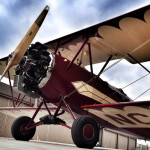
Kristi and I recently had the opportunity to work with the very talented duo of Michael and Maren Brajkovich on our engagement photos.

We really wanted to do something special, something that reflected our passion and history together. So it goes without saying that aviation would be a part of it.

We originally had the idea to shoot over at Chino Airport, where we’d have access to not only my Pitts S-2B, but also the many amazing warbirds at the Planes of Fame. Imagine it: Mustangs, P-38s, Spitfires, Corsairs. Ah, the possibilities!

Unfortunately, we found ourselves with a few time constraints. In addition, it turned out to be one of the hottest days of the year — nearly 105 degrees at SNA, which is only a mile from the ocean. So we regrouped and ended up doing the photos at John Wayne Airport with Sunrise Aviation‘s recently acquired S-2B standing in for good o’l 1191. Aside from the three-blade MT composite propeller, the two aircraft look virtually identical from the outside. And to be honest, the metal two-blade Hartzell prop probably evokes a more vintage feel anyway.

Kristi, ever the creative soul, put together a 1930′s-era wardrobe to accompany the biplane, and off we went! Snap snap snap…. and before we knew it, two hours had gone by. Despite the searing heat, we had a blast.

After finishing with the Pitts, we switched into some casual contemporary clothes and flew to Catalina Island in a Cirrus SR-22. This also happens to have re-created our first date! If you can believe it, it was even hotter on the island.

We returned a few hours later and, after a break, met up with Michael and Maren in Old Town Orange where we took advantage of the late-afternoon light for some fun shots around one of our favorite weekend hangouts, Byblos Cafe.

We can’t say enough good things about Michael & Maren (aka “Applemoon Photography“). They were fun, energetic, creative, talented, and open to ideas other photographers might have laughed at. In addition, they came all the way down from San Luis Obispo to spend the entire day working with us.

So, have a look at the pictures. What do you think??

These Are A Few Of My Favorite Things

Now is this a sweet looking pair of machines or what? A 1993 Pitts S-2B and a 2008 Honda Accord Coupe in matching paint:

I had the opportunity to get back into the Pitts yesterday and when I saw the two of them together I had to take a picture. It’s so rare that both the car and the plane are clean at the same time.

I was out at CNO to take Dan for a flight. His flight review (an FAA-mandated recurrent training requirement) was due and I owed him a favor for ferrying me out to Borrego last fall. I had needed to get out there to retrieve the Pitts after the Acrofest. I was the Contest Director for that competition. And a competitor. And a judge. And… I’ll never do that again. It was a crazy time, even by my standards.

Anyway, Dan wanted to try some advanced spin training as part of his flight review, so we focused on flat and accerated spins modes. After that, I went up for a solo flight to work on the 2007 intermediate known sequence. I’m trying to get an early start on preparing for the upcoming competition season.

The 2007 season was basically missed by all of us at Cloud Dancers because the airplane was undergoing a particularly heavy maintenance interval which lasted for most of the spring and summer. The timing was unfortunate, but after the aircraft came off leaseback it only made sense to get it into good working order. The wings were off, the prop was overhauled, fabric & paint were touched up, the top end was overhauled, and she was cleaned, rigged, inspected, and so on.

When I got back to Chino, I spent some time just shooting landings in the pattern. It’s such a blast to go from 1300′ AGL to zero in about 15 seconds. The airplane pretty much climbs at the same rate. I had forgotten how much sprightlier the S-2B is when flown solo vs. with two people on board. Losing that 200 lbs up front really makes a difference!

I’ve been doing a fair bit of Pitts flying lately, but most of it has been dual in an S-2C owned by one of my recent Part 61 private pilot grads. This airplane was originally owned by a good friend from the aerobatic competition circuit named Reinaldo. The person Reinaldo sold it to installed a wicked six-camera video system and sold it again shortly thereafter, leaving my student as the lucky beneficiary of this upgrade. Here we are preparing to start up during a recent flight:

Turbine Toucan

I first saw this on the wall in a restroom at Cable Airport. No joke. For reasons I can’t begin to fathom, someone had taped a photo of this aircraft to the wall:

Turbine Toucan biplane

It’s called Turbine Toucan, and it’s just another ho-hum aerobatic biplane, just like my Pitts. Except that it boasts something most modern jet fighters can’t even claim (no, I’m not referring to the paint scheme): a positive thrust-to-weight ratio.

This thing weighs 2000 lbs and the turbine engine puts out 3300 lbs of thrust. That’s an amazing 1.65:1 ratio, enough to accelerate in a vertical climb. Indefinitely.

Even fighter jets with positive thrust-to-weight ratios — of which there are few — can’t match Turbine Toucan’s performance in this department. The F-15 Eagle, for example, is about 1.12:1. Even the latest and greatest generation of jets like the F-22 Raptor (at 1.26:1) and F-35 (1.22:1 with 50% fuel) can’t compare.

Among aerobatic aircraft with reciprocating powerplants, only the most pumped up Sukhois and Edges approach the performance of that magical 1:1 ratio. I ran the numbers on the Pitts S-2B and was surprised to find 0.95:1, because it sure doesn’t feel that sprightly on the uplines. Maybe I need to go on a diet?

Eh. More likely it’s due to the high level of drag from the Pitts’ biplane design. That’s my story and I’m sticking with it.

This isn’t the first time someone’s had the bright idea of putting a big turbine engine on a featherweight aerobatic airplane. Wayne Handley did it back in the late 90′s with his Oracle Turbo Raven. Equipped with a 750 hp Pratt & Whitney PT6A turboprop powerplant, that monoplane sported a 1.47:1 thrust-to-weight ratio. Still not up to the Turbine Toucan standard.

Handley frequently demonstrated a vertical climb where he would stop in mid-air, hover, and then accelerate upward again. I never had the opportunity to see the Turbo Raven in person, but from what I’ve been told it left quite an impression. I think of it has a GA equivalent of vectored thrust. Handley would take off directly into a half Cuban, then perform a vertical half-roll and push over into a steep descent which ended with a landing in the exact same spot he’d departed from 60 seconds earlier.

Sadly, the Raven was badly damaged in a 1999 accident (see video). Wayne Handley was injured but has since recovered and still trains aerobatic pilots at his private airfield in central California.

Being a biplane, I can’t help but wonder if the Turbine Toucan will beat the Turbo Raven’s time-to-climb records. Toucan has a higher thrust to weight ratio, but will certainly be hampered by higher drag. The Raven climbed to 3,000 meters (9,842 feet) in one minute and nine seconds seconds, a rate of 8,560 fpm.

Initial testing of the Turbine Toucan yielded an 8,400 fpm climb rate at about 50% power, but that was based on a sea level climb to 4,500′ MSL. Even with a turbine engine, as the airplane climbs, thrust will decrease. Drag will decrease as well in the thinner air, so I think it’ll be close.

As a biplane owner, I’m going to have to root for the Turbine Toucan. (Sorry, Wayne!)


Switch to our mobile site